Dear Readers,
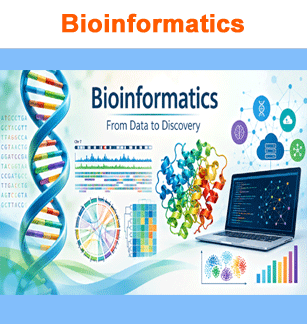
This issue provides an overview of bioinformatics, covering its fundamentals, history, applications in healthcare, and relevance to ophthalmology. It also highlights the emerging integration of bioinformatics with artificial intelligence, including applications in ophthalmic research and clinical practice.
Edited by:
Dr. Bharanidharan Devarajan, Scientist, AMRF
Dr. K. Kiran Kumar, AMRF
Your feedback will help us improve the newsletter. Please send in your feedback at eyesite@aravind.orgThank You. Have a happy reading. Regards, Library Team |
|
- WHAT IS BIOINFORMATICS?
This webpage contains detailed information about Bioinformatics.
- BIOINFORMATICS
The NIH website explains how bioinformatics uses computational tools to collect, analyze, and interpret genetic and genomic data, supporting research and improving our understanding of health and disease.
- WHAT IS BIOINFORMATICS
This webpage explains how bioinformatics helps to interpret and give meaning to biological data. The information generated through bioinformatics can be used to diagnose patients with rare conditions, track and monitor infectious organisms as they spread through populations, and identify the most appropriate treatment for individual patients with cancer.
- WHAT IS BIOINFORMATICS
This webpage from DTU Health Tech highlights the wide range of applications of bioinformatics, covering areas from personalised medicine, where an individual’s genome is used to predict the optimal treatment, to the application of machine learning for studying receptor–ligand interactions in biological systems.
- A BRIEF HISTORY OF GENOMICS AND BIOINFORMATICS (WITHOUT THE BRAIN MELTDOWN)
This article gives the details of the history of Bioinformatics.
- HISTORY AND MAJOR MILESTONES IN BIOINFORMATICS
This webpage provides a chronological overview of how bioinformatics developed from early protein sequence analysis and biological databases to modern AI- and machine-learning-based approaches.
|
|
- KEC BIOINFORMATICS CORE
This webpage contains information about the Kellogg Eye Center (KEC) Bioinformatics Core, which supports researchers in analyzing omics and large-scale biological datasets to address critical research questions.
- HUMANIZED SOLUTIONS’ POST
This poster presents a mixed-methods project exploring how Patient and Public Involvement and Engagement (PPIE) can be more effectively integrated into retinal disease research, with a particular focus on bioinformatics and data integration strategies.
- CENTRE FOR OPHTHALMIC BIOINFORMATICS
This webpage links to the Centre for Ophthalmic Bioinformatics, highlighting the role of bioinformatics in ophthalmology through computing, managing big data, developing diagnostic tools, problem-solving, and collaboration and communication.
- WHY INFORMATICS: USING PERSONALIZED DATA TO IMPROVE EYE HEALTH
This webpage highlights the importance of informatics in ophthalmology, particularly its role in improving the delivery of eye care and enhancing the quality of care provided to patients with eye diseases.
- EXPLORING THE GENETICS OF GLAUCOMA THROUGH BIOINFORMATICS RESEARCH
The goal of this research study is to uncover potential genes or genetic components that are associated with the behaviour of glaucoma, ultimately to provide genetic information and biomarkers that can potentially assist in the understanding of this disease.
- ADVANCES IN BIOINFORMATICS TECHNIQUES FOR OPHTHALMIC DISEASES
The article provides a detailed overview of the applications of bioinformatics in various ophthalmic conditions, including dry eye disease, keratitis, cataract, glaucoma, uveitis, and retinal diseases.
- APPLYING BIOINFORMATIC TOOLS TO BETTER UNDERSTAND EYE DISEASES
This thesis explores the bioinformatics approaches based on the central dogma as a model for exploring the experimental models for human eye diseases.
|
|
- BIOINFORMATICS & ARTIFICIAL INTELLIGENCE
This webpage highlights “AI in Bioinformatics: The Future of Healthcare,” exploring how artificial intelligence and bioinformatics can transform healthcare through advanced data analysis, improved diagnosis, and personalized medicine.
- BIOINFORMATICS AND ARTIFICIAL INTELLIGENCE
This webpage provides bioinformatics analysis of omics data, including data processing, statistical analysis, visualization, protein and gene function annotation, and pathway analysis.
- WHY AI IS BECOMING ESSENTIAL IN THE BIOINFORMATICS INDUSTRY
This page provides an overview of how artificial intelligence is transforming bioinformatics. With the rapid growth of genomic, transcriptomic, and other biological data, AI is helping researchers analyze complex datasets more efficiently and accurately, while creating new opportunities in bioinformatics and biotechnology.
- TRANSFORMING LIFE SCIENCES: THE REVOLUTIONARY IMPACT OF AI ON BIOINFORMATICS
This webpage explains how AI and bioinformatics are transforming life sciences by enabling efficient analysis of complex biological data, accelerating drug discovery, and supporting personalized medicine.
- BIOINFORMATICS AND AI: THE FUTURE OF BIOLOGICAL RESEARCH
This webpage explores how bioinformatics and artificial intelligence (AI) are transforming biological research by helping scientists analyze massive biological datasets, accelerate discoveries, and gain deeper insights into life, health, and disease.
- ARTIFICIAL INTELLIGENCE AND BIOINFORMATICS: A JOURNEY FROM TRADITIONAL TECHNIQUES TO SMART APPROACHES
This article explores the evolving role of AI-driven tools in accelerating research, interpreting complex data, and advancing biomedical science.
- ROLE OF ARTIFICIAL INTELLIGENCE IN BIOINFORMATICS AND INFORMATION EXTRACTION SYSTEMS
The primary aim of this research is to examine the function of AI within the realms of bioinformatics and information extraction through a combination of quantitative and qualitative approaches.
- ARTIFICIAL INTELLIGENCE FOR OPHTHALMOLOGY
This article reviews how AI, big data, and clinical decision-support systems can improve ophthalmic referrals, screening, and clinical practice. It highlights their potential to support early detection, referral prioritization, workflow optimization, and efficient patient care.
|
|
You can also refer your friends to register with the innovative resources. Send in your friend's e-mail id to us at eyesite@aravind.org with the subject line Register my friend's id!
Subscribe Sitenews
If you want to unsubscribe from our mailing list and from all our communications please click on the following link:
Unsubscribe Sitenews
Address:
Vision 2020 e-resource team,
Lions Aravind Institute of Community Ophthalmology,
1, Annanagar, Madurai - 625 020,
Tamil Nadu, India,
E-mail:eyesite@aravind.org
Phone: 91-452-2537580
| |
|


 BIOINFORMATICS
 BIOINFORMATICS ROLE IN HEALTH CARE
 BIOINFORMATICS IN EYE HEALTH
 BIOINFORMATICS AND ARTIFICIAL INTELLIGENCE
 Talk To Us